
New Orleans Directory Collections
The City Archives directory collection is the main catalog for New Orleans city directory work. It joins early microfiche, two microfilm runs, later print books, suburban volumes, telephone books, and reverse directories. Those formats do not offer the same years or search method. Record the edition, page, publisher or series, and access point for every useful entry.
| Collection | Years | Where Held | Access |
|---|---|---|---|
| Early city directories | 1811; selected years 1822-1859 | City Archives | Microfiche; digital coverage varies |
| 16mm and 35mm directories | 1811-1965; 1861-1960 | City Archives and NOPL | Microfilm |
| Gale City & Business Directories | 1805-1929 | Louisiana Library Connection | Remote with NOPL card |
| Digitized directory run | 1861-1960, not every year | Ancestry and HeritageQuest | Library or card access |
| Printed New Orleans volumes | 1961-present, with gaps | City Archives and NOPL | Print consultation |
| Polk suburban and Haines CrissCross | 1955 onward; 1966 onward | City Archives | Print consultation |
| White and yellow pages | 1966-2017; 1969-2018 | City Archives and NOPL | Print, with missing years |
No regular city directory is held for 1862 through 1865. The Archives also says its 1811-1860 run is being digitized and is not all online. A failed web search can mean the volume is on film, in print, or absent, rather than that a person was absent from New Orleans.
New Orleans Directory Eras
New Orleans directories began before Louisiana statehood, while the record landscape still reflected colonial wards and early municipalities. The city had three legal municipalities from 1836 to 1852, alongside the separate City of Lafayette. A district or municipality in an early entry may not match a modern neighborhood name.
The collection then moves through the Civil War gap, the rise of address cross-references, suburban Polk books, Haines reverse volumes, and late telephone directories. This timeline helps select the right tool rather than applying a modern address search to an era when entries were filed only by name.
| Before 1812 | Directory publishing begins before statehood. |
|---|---|
| 1862-1865 | No directories appear in the regular local run. |
| 1932 | The street-address cross-reference first appears. |
| 1955 | R.L. Polk suburban volumes begin in the local collection. |
| 1966 | Haines CrissCross begins; white-page holdings also start. |
| 1970s | Some directories add telephone-number order. |
Decode New Orleans Directory Entries
The Archives' entry-reading guide shows why the key matters. Benjamin H. Bell's line includes spouse Annie C., the shortened role “genl supt,” New Orleans Public Service, and a home on South Derbigny. Bernice W.'s entry uses “wid Lincoln” and “r” before a Toulouse Street address. These marks are evidence, but each must be read under that volume's own rules.
View the City Archives entry guide beside its scanned examples.
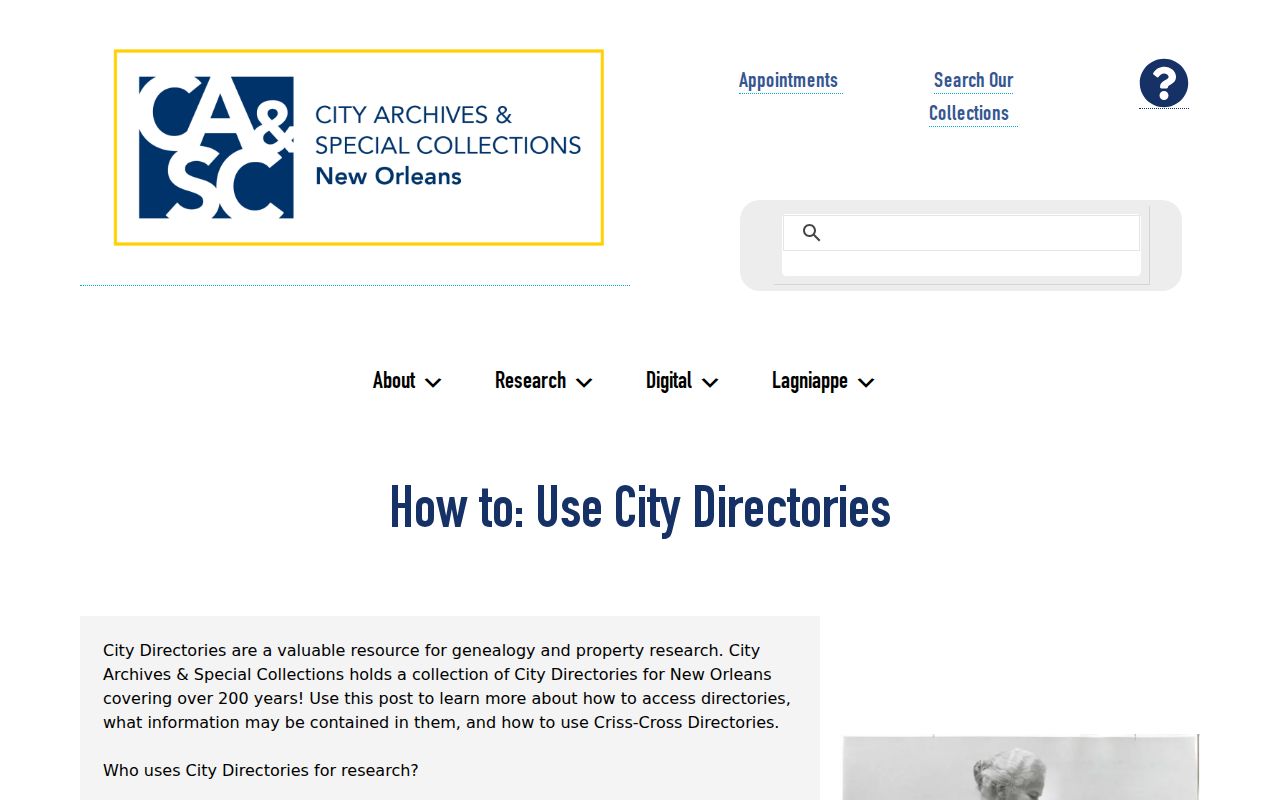
The guide shows how brief marks separate a spouse, trade, household role, work site, and dwelling.
| Name | Usually surname and a shortened given name or initials. |
|---|---|
| Family notation | A spouse may be in parentheses; “wid” names a deceased spouse. |
| Work | A trade, office, firm, or institution may appear in brief form. |
| Address | “h” marks head of household and “r” marks a resident in the cited examples. |
| Street section | From 1932, it can turn a known address into an occupant name. |
A New Orleans city directory entry does not prove ownership. It may reflect canvassing, a business listing, or facts current only when the book was made. Keep the exact spelling and marks until a second source supports an expanded name.
- Criss-cross directory
- A later volume arranged by street address or phone number rather than surname.
- Householder index
- A list centered on the named person linked to a household, not a full list of occupants.
- Abbreviation key
- The edition's front matter that defines its marks, trades, directions, and shortened words.
New Orleans Work and Home Clues
A striking 1855 Cohen's Directory example lists H.G. Hodgson as a clerk at 36 Gravier Street and gives a dwelling at 107 Constance. That one line warns against treating the first address as the home. It also shows the human value of New Orleans city directories: a work link can distinguish two people with similar names.
Copy both addresses with their labels. Then compare the dwelling with a census or household record and the work site with a business listing or newspaper. Occupations changed, firms moved, and abbreviated names recur. A pair of addresses, a trade, and a year forms a stronger identity key than a surname alone.
Entry rule. Preserve the line as printed, including punctuation and abbreviations, before writing a modern interpretation.
Search New Orleans Directories Online
The NOPL historic databases connect readers to Gale, HeritageQuest, Ancestry, newspapers, Fold3, and fire-insurance maps. Gale spans 1805-1929, while the digitized 1861-1960 set appears through Ancestry and HeritageQuest with gaps. Access differs: Ancestry is for in-library use, while HeritageQuest and Gale can be reached with a library card under the terms listed by NOPL.
Open the New Orleans Public Library historic database list before choosing a collection.
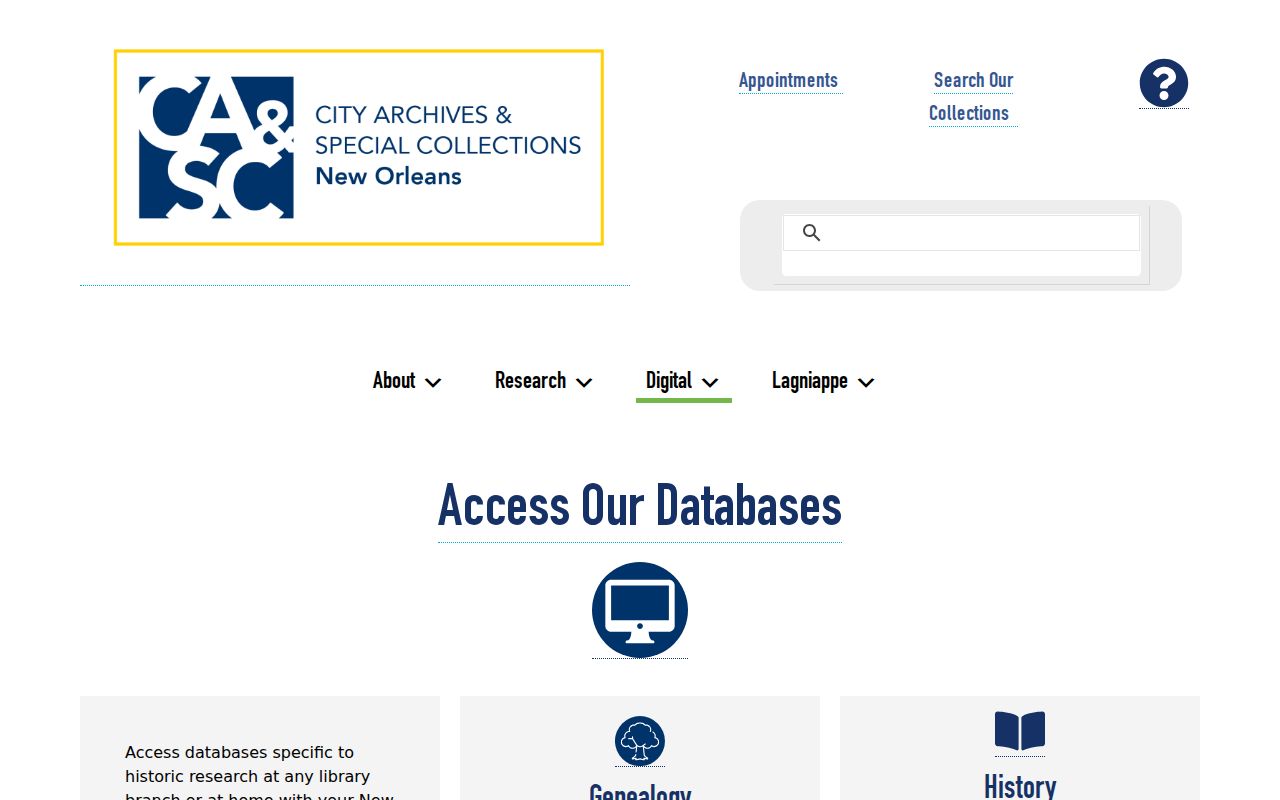
The captured page points beyond a simple name box, so browse page images and index pages when a text search fails.
For a print or film gap, contact the City Archives at 219 Loyola Avenue. Research is by appointment, generally Monday through Friday from 10 a.m. to 5 p.m.; Ask an Archivist or 504-596-2610 is the sound pre-visit route. Staff can help identify a format, but a focused request should still include a name, year range, street, and known family or work link.
Trace New Orleans Families by Year
Family history works best as a sequence, not a one-book search. Pick one year where the person is known, then move in small jumps. Pair directory facts with census years, notices, and church or court records. A move, death, changed trade, or spouse notation often becomes clear only after two nearby editions are compared.
- Find the person in one known New Orleans directory year and copy the full entry.
- Check an earlier and later edition, recording all changes in name, spouse, work, and address.
- For 1932 and later, test the address in the street or criss-cross section.
- Pair the nearest public census schedule with the directory evidence, keeping ward and municipality labels.
- Close a disappearance with an obituary, cemetery entry, succession, church register, or another directory.
Before 1932, an address-first search needs more work. Normalize an old street name and house number with the City Archives indexes for 1852-1938, then return to the name section. For modern address-keyed ownership, shift to the New Orleans street directory process instead of making the historical volume carry a claim it cannot support.
Extend New Orleans Directory Leads
The City Archives genealogy guide pairs directories with an obituary index covering 1804-1972, court successions, wills, estate inventories, burial records, and church registers. NewsBank adds the Times-Picayune from 1837 onward, New Orleans Item from 1877-1958, New Orleans States from 1916-1957, and States-Item from 1960-1979.
An index is a pointer, not the full notice. Use the cited date and paper to retrieve the clipping, then compare relatives, parish, funeral site, and address with the city directory entry. HNOC's cemetery database adds tomb names, images, condition reports, and maps for St. Louis Nos. 1 and 2. City cemetery records before 1950 are on NOPL microfilm, while later administrative records are not generally open to researchers.
New Orleans Directory Research Rooms
The best repository depends on the person and era. The Louisiana Historical Society research directory routes researchers to the City Archives, Amistad Research Center, Archdiocesan Archives, Tulane collections, and other local institutions. The captured resource page helps frame that choice.
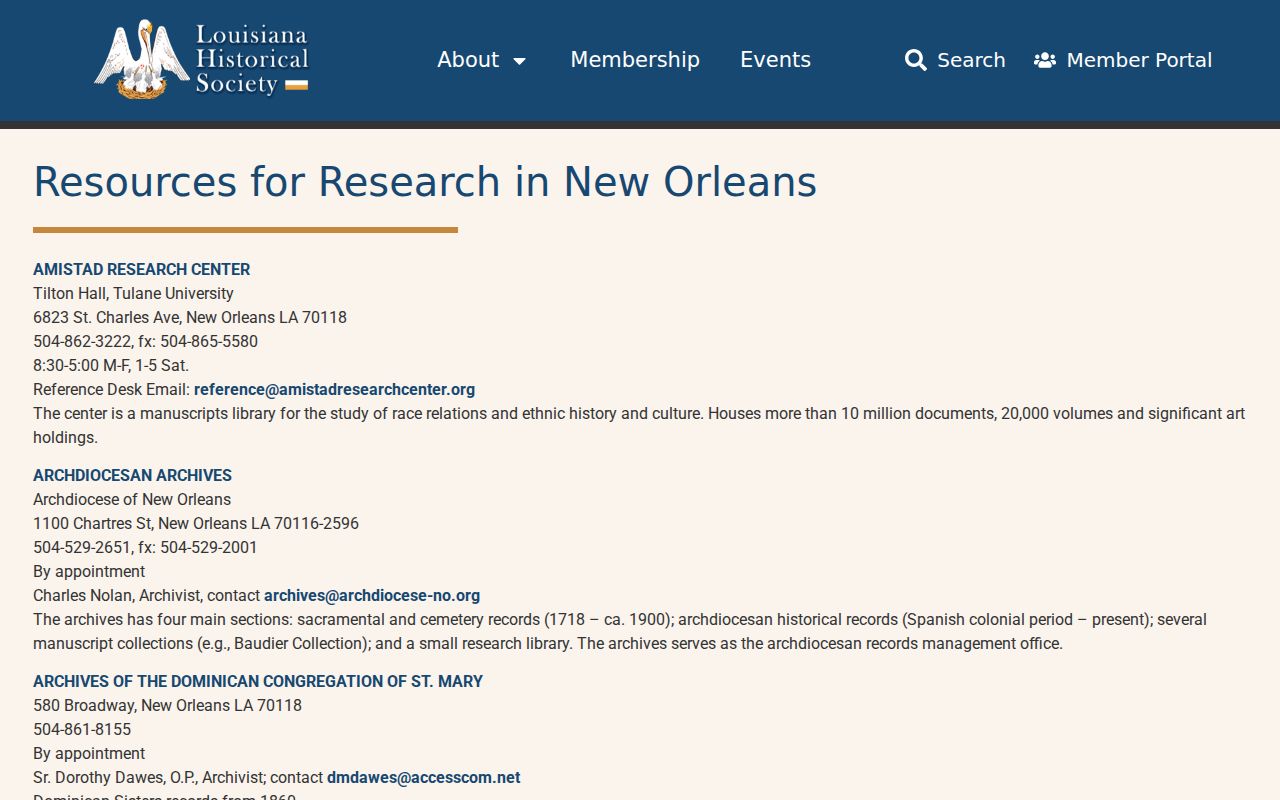
The list matters because no single archive holds every New Orleans community, faith, plan, or family paper.
The Archdiocese documents sacramental and cemetery records from 1718 to about 1900 and requests names, dates, and a church. Amistad is especially important for African American and race-relations collections. Tulane's architectural archive supplies plans and early Sanborn material, while the Louisiana Historical Center holds colonial documents. Ask an archivist about a specific person or collection rather than assuming each repository has a searchable city directory.
Verify New Orleans Directory Matches
A gap, misspelling, or missing scan is not proof that a New Orleans resident left the city. Search name variants, browse the page near the expected surname, inspect the volume key, and compare two nearby years. Migration through French, Spanish, Caribbean, Creole, Irish, German, Italian, Jewish, Latin American, Asian, and Black communities also changed spellings and labels across the record trail.
Use spouse, street, trade, parish, employer, witnesses, and date as checks. A directory resident is not always a deed owner, and an address may be a workplace rather than a dwelling. When the historical find needs a current official check, use the New Orleans resident lookup workflow. Keep historical facts tied to their source date, especially after Katrina-era moves and rebuilding.
Note: A negative directory search is inconclusive until the edition, format, missing-year list, and likely spelling variants have all been checked.